New & Noteworthy
ND Gems
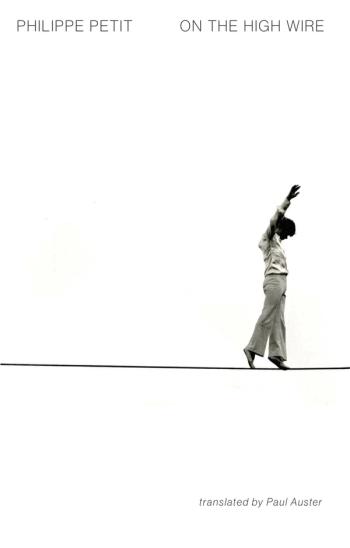
On the High Wire
Literature by Philippe Petit
Translated from French by Paul Auster
In this poetic handbook, written when he was just twenty-three, the world-famous high-wire artist Philippe Petit offers a window into the world of his craft. Petit masterfully explains how preparation and self-control contributed to such feats as walking between the towers of Notre Dame and the World Trade Center. Addressing such topics as the rigging of the wire, the walker’s first steps, his salute and exercises, and the work of other renowned high-wire artists, Petit offers us a book about the ecstasy of conquering our fears and reaching for the stars.
Buy the paperback for $13.95

Two American Scenes
Poetry by Lydia Davis and Eliot Weinberger
Two remarkable prose stylists — friends since high school — transform found material from the nineteenth century into mesmerizing poem-essays.
It was given to me, in the nineteenth century, to spend a lifetime on his earth. Along with a few of the sorrows that are appointed unto men, I have had innumerable enjoyments; and the world has been to me, even from childhood, a great museum. — Lydia Davis
Bad rapids. Bradley is knocked over the side; his foot catches under the seat and he is dragged, head under water. Camped on a sand beach, the wind blows a hurricane. Sand piles over us like a snowdrift. — Eliot Weinberger
Buy the paperback for $10.95

On the Edge
by Rafael Chirbes
Translated from Spanish by Margaret Jull Costa
With a contribution by Valerie Miles
On the Edge opens in a swamp on the outskirts of Olba, Spain, a town wracked by despair after the economic bubble bursts. Stuck in this corrupt, defeated town is Esteban—his small factory bankrupt and his investments stolen by a “friend.” Much of the novel unfolds in Esteban’s raw and tormented monologues. But other voices resound from the wreckage—soloists stepping forth from the choir with their own terse, hypnotic rants about debt, prostitution, and ruin. However, now and again, with his own majestic authorial voice, Chirbes interrupts the chorus, allowing a lyrical note to usher in profound if uncertain hopes. On the Edge, as Valerie Miles writes in her afterword, “is masterful, a centrifugal novel with sentences like sticky tentacles that clutch onto readers and suck them into a swirling, tempestuous, pulsating center.”
Buy the paperback for $16.95
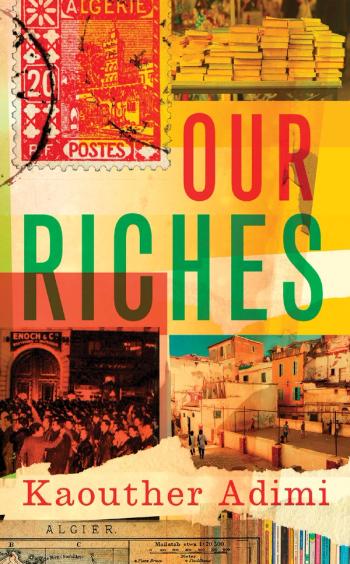
Our Riches
Fiction by Kaouther Adimi
Translated by Chris Andrews
Our Riches celebrates quixotic devotion and the love of books in the person of Edmond Charlot, who at the age of twenty founded Les Vraies Richesses (Our True Wealth), the famous Algerian bookstore/publishing house/lending library. He more than fulfilled its motto “by the young, for the young,” discovering the twenty-four-year-old Albert Camus in 1937. His entire archive was twice destroyed by the French colonial forces, but despite financial difficulties (he was hopelessly generous) and the vicissitudes of wars and revolutions, Charlot (often compared to the legendary bookseller Sylvia Beach) carried forward Les Vraies Richesses as a cultural hub of Algiers.
Our Riches interweaves Charlot’s story with that of another twenty-year-old, Ryad (dispatched in 2017 to empty the old shop and repaint it). Ryad’s no booklover, but old Abdallah, the bookshop’s self-appointed, nearly illiterate guardian, opens the young man’s mind. Cutting brilliantly from Charlot to Ryad, from the 1930s to current times, from WWII to the bloody 1961 Free Algeria demonstrations in Paris, Adimi delicately packs a monumental history of intense political drama into her swift and poignant novel. But most of all, it’s a hymn to the book and to the love of books.
Buy the paperback for $15.95
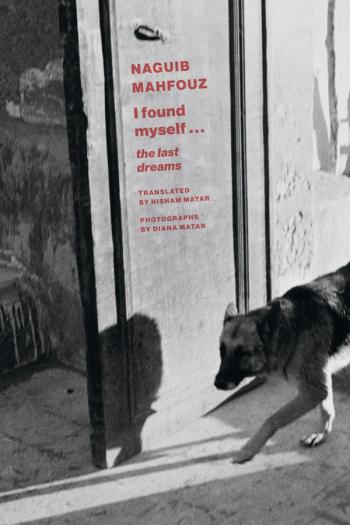
I Found Myself
In his final years, the Egyptian master storyteller and Nobel laureate Naguib Mahfouz drew on his dreams, combining the mystery of what we experience in the night with the deep wells of his narrative art. These last dreams, stunning poetic vignettes—now brought beautifully into English for the first time by the acclaimed writer Hisham Matar—appear here with dreamlike photographs by the famous American photographer Diana Matar, which both mysteriously rhyme with Mahfouz’s nocturnal reveries and, allowing the reader a chance to dream in turn, opening up the texts. These sketches and stories are tersely haunting miniatures. Recurring female characters may embody Cairo herself, especially one much-missed lover from Mahfouz’s youth. Friends, family, rulers of Egypt, and many beautiful women all float through these affecting, brief tales dreamed by a mind too fertile ever to rest, even in slumber. A tender, personal introduction by Hisham Matar, recollecting how he and his wife met Mahfouz in Cairo not long after the assassination attempt on the author, is moving and likewise indelible.
Buy the paperback for $16.95

H of H Playbook
Literature by Anne Carson
- Illustrated by Anne Carson
H of H Playbook is an explosion of thought, in drawings and language, about a Greek tragedy called Herakles by the 5th-century BC poet Euripides. In myth Herakles is an embodiment of manly violence who returns home after years of making war on enemies and monsters (his famous “Labors of Herakles”) to find he cannot adapt himself to a life of peacetime domesticity. He goes berserk and murders his whole family. Suicide is his next idea. Amazingly, this does not happen. Due to the intervention of his friend Theseus, Herakles comes to believe he is not, after all, indelibly stained by his own crimes, nor is his life without value. It remains for the reader to judge this redemptive outcome.
“I think there is no such thing as an innocent landscape,” said Anselm Kiefer, painter of forests grown tall on bones.
Buy the hardcover for $25.95

Mojave Ghost
Poetry by Forrest Gander
Mojave Ghost initiates an unusually tender bond with the reader as it chronicles an intimate relationship with arresting honesty and vividness. Moving through grief and loss towards a renewal that never sidesteps the wholeness of experience, Gander’s new collection discovers an articulate language for the merging of exterior and interior landscapes. Gander, trained as a geologist, walked along much of the 800-mile San Andreas Fault toward the desolate town of his birth and found himself crossing permeable dimensions of time and space, correlating his emotions and the stricken landscape with other divisions: the fractures and folds underlying not only our country, but any self in its relationship with others. The result is this moving new collection that unforgettably describes a spiritual and physical journey. With its confiding tones and candid self-examination, Mojave Ghost is Gander’s most inviting and poignant book yet.
Buy the paperback for $15.95

Dirty Poem
Poetry by Ferreira Gullar
Translated from Portuguese by Leland Guyer
Dirty Poem was written in 1975 in Buenos Aires when Ferreira Gullar was in political exile from the Brazilian dictatorship. An epic work, it draws on the poet’s memories of his seaside adolescence during World War II and deals openly with the “dirty” shamefulness of a socioeconomic system that abuses its citizens with poverty, sexism, greed, and fear. The scholar Otto Maria Carpeaux wrote: “Dirty Poem deserves to be called ‘National Poem’ because it embodies all of the experiences, victories, defeats, and hopes in the life of the Brazilian citizen.”
_Oh, my green city my humid city ever beaten by many winds rustling your days at the entrance to the sea my sonorous city spheres of heavy winds _
Buy the paperback for $10.95
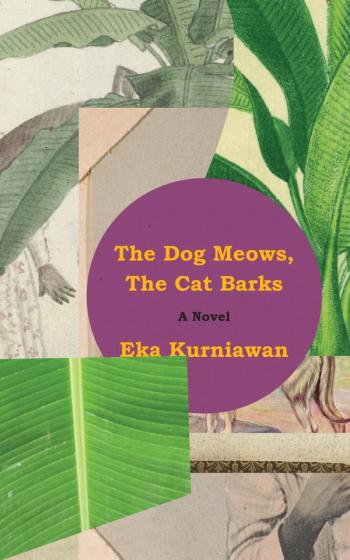
The Dog Meows, The Cat Barks
Fiction by Eka Kurniawan
Translated from Indonesian by Annie Tucker
Sato Reang enjoys an idyllic childhood of soccer, cricket fighting, and mischief in his Indonesian village—until the day he must be circumcised, and his observant father forces him into a life of Islamic piety. For years, Sato outwardly obeys his father, but all the while the boy chafes at the strictures of his religious routine, longing for everyday pleasures and vowing to himself that he will “become a child who was not pious.” His freewheeling linked anecdotes—mixing worldliness and naïveté, cruelty and innocence—are narrated with a toggling between first and third person (“I”/“he” or “Sato Reang”) that potently conveys his disassociation. His adolescent, hormone-fueled crotchetiness expresses dissent: I stopped going to mosque. I no longer joined in worship. I never said my prayers before bed. Sato Reang eats with his left hand–so stupid–and barges in where he pleases, without calling out a greeting. If I was feeling lazy, I’d just piss on a banana tree, and I wouldn’t wash myself off after. But amid various mysterious portents and even within the hilarity, Sato’s callow sangfroid (with its undercurrents of pain and shame)—and his comic pranks— soon invite tragedy.
A psychologically timeless story—anyone who’s ever had an overbearing parent and resented them will relate—The Dog Meows, the Cat Barks is Eka Kurniawan’s most contemporarily relevant book: he’s thinking about (and rejecting) militancy and moral certitude of any kind.
Buy the paperback for $14.95
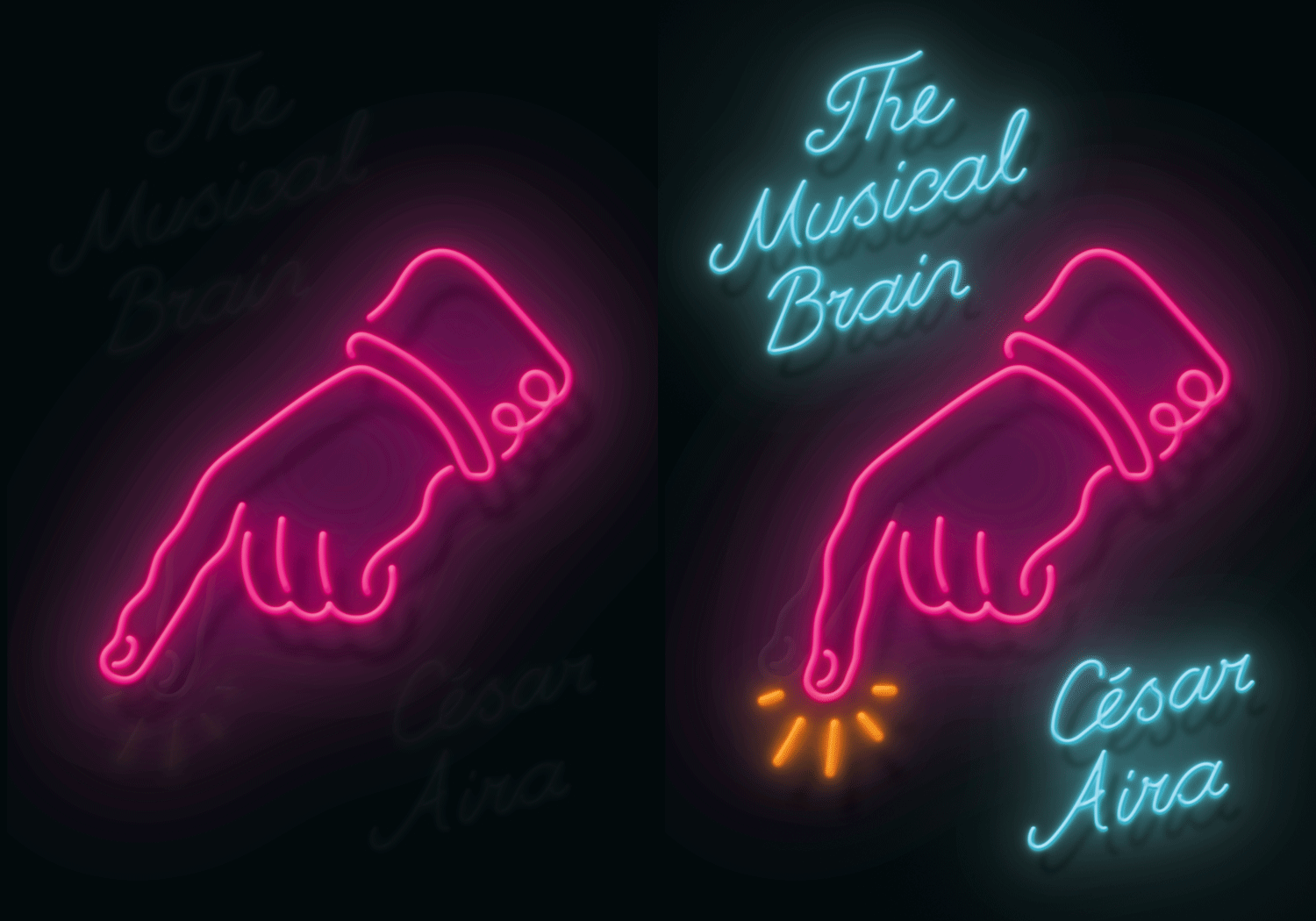
The Musical Brain
by César Aira
Translated from Spanish by Chris Andrews
The author of at least eighty novels, most of them no more than 96 pages long, César Aira has been called “the author who can’t be stopped” by the New York Review of Books. The Musical Brain & Other Stories is the first collection of his stories to appear in English and comprises twenty tales about oddballs, freaks, and crazies. Aira, with his fuga hacia adelante or “flight forward” into the unknown, gives us imponderables to ponder and bizarre and seemingly out-of-context plot lines to consider, as well as thoughtful and passionate takes on everyday reality. The title story, published in the New Yorker, is the centerpiece of this exhilarating collection of characters, places, and ideas—the crème de la crème of Aira’s many short stories.
Buy the hardcover for $29.95