Donald Yates
Donald Yates


Labyrinths
Fiction by Jorge Luis Borges
Translated from Spanish by Donald Yates and James Irby
Edited by Donald Yates and James Irby
With a contribution by William Gibson
The groundbreaking trans-genre work of Argentinian writer Jorge Luis Borges (1899-1986) has been insinuating itself into the structure, stance, and very breath of world literature for well over half a century. Multi-layered, self-referential, elusive, and allusive writing is now frequently labeled Borgesian. Umberto Eco’s international bestseller, The Name of the Rose, is, on one level, an elaborate improvisation on Borges’ fiction “The Library,” which American readers first encountered in the original 1962 New Directions publication of Labyrinths. This new edition of Labyrinths, the classic representative selection of Borges’ writing edited by Donald A. Yates and James E. Irby (in translations by themselves and others), includes the text of the original edition (as augmented in 1964) as well as Irby’s biographical and critical essay, a poignant tribute by Andre Maurois, and a chronology of the author’s life. Borges enthusiast William Gibson has contributed a new introduction bringing Borges’ influence and importance into the twenty-first century.
Buy the paperback for $15.95
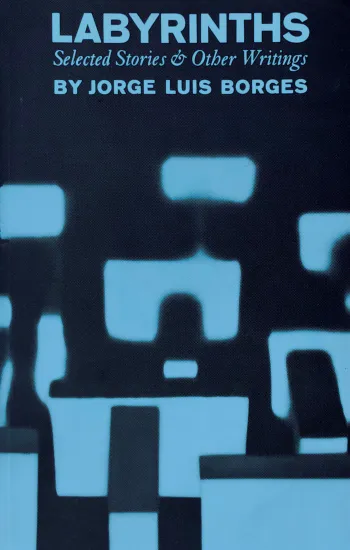
Labyrinths: Selected Stories & Other Writings
Fiction by Jorge Luis Borges
Translated from Spanish by Donald Yates and James Irby
Since it was first published by New Directions in 1962, Labyrinths has transformed and enriched our collective imaginations, introduced new possibilities for literature, and astonished generation after generation of readers and writers. This groundbreaking collection of stories, essays, and parables still serves as a perfect introduction to Borges’s imaginative universe: writing that is multilayered, paradoxical, recursive, elusive, and allusive; writing that has now come to be known as “Borgesian.”
For countless readers in the past decades, including Pope Francis and Gabriel García Márquez, Umberto Eco and Ursula K. Le Guin, the stories contained in Labyrinths—“The Garden of Forking Paths,” “The Lottery in Babylon,” and “The Library of Babel”—introduced not only a monumental writer but a new way of thinking about literature and the modern world.

Everything and Nothing
Fiction by Jorge Luis Borges
Translated from Spanish by Donald Yates
Everything and Nothing collects the best of Borges’ highly influential work — written in the 1930s and ‘40s — that foresaw the internet (“Tlön, Uqbar, Orbis Tertius”), quantum mechanics (“The Garden of Forking Paths”), and cloning (“Pierre Menard, Author of the Quixote”). David Foster Wallace described Borges as “scalp-crinkling… Borges’ work is designed primarily as metaphysical arguments… to transcend individual consciousness.”
Labyrinths
Fiction by Jorge Luis Borges
Translated from Spanish by Donald Yates and James Irby
Edited by Donald Yates and James Irby
With a contribution by William Gibson
The groundbreaking trans-genre work of Argentinian writer Jorge Luis Borges (1899-1986) has been insinuating itself into the structure, stance, and very breath of world literature for well over half a century. Multi-layered, self-referential, elusive, and allusive writing is now frequently labeled Borgesian. Umberto Eco’s international bestseller, The Name of the Rose, is, on one level, an elaborate improvisation on Borges’ fiction “The Library,” which American readers first encountered in the original 1962 New Directions publication of Labyrinths. This new edition of Labyrinths, the classic representative selection of Borges’ writing edited by Donald A. Yates and James E. Irby (in translations by themselves and others), includes the text of the original edition (as augmented in 1964) as well as Irby’s biographical and critical essay, a poignant tribute by Andre Maurois, and a chronology of the author’s life. Borges enthusiast William Gibson has contributed a new introduction bringing Borges’ influence and importance into the twenty-first century.
Buy the paperback for $15.95