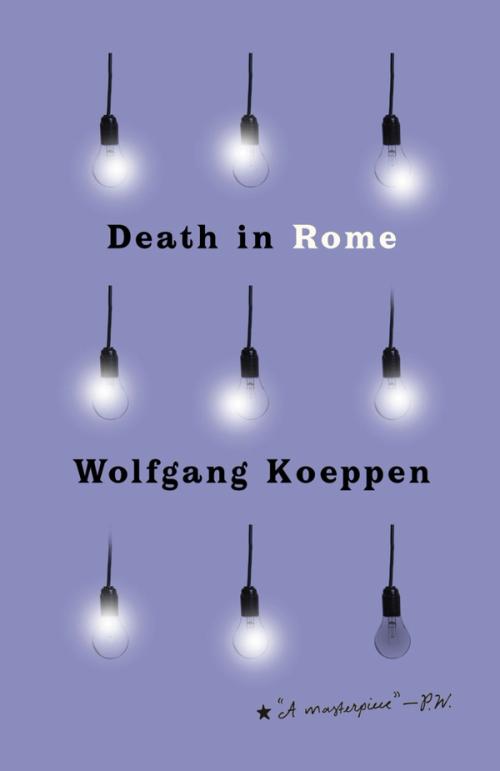
Death in Rome is the most devastating novel about the Germans that I have ever read, and one of the most arresting on any subject. It takes a German family—not a real German family, not even a caricature of a German family, but a prototypical German family that George Grosz would have had the bile but not the wit to invent, and Musil or Mann the wit but not the bile—and brings them to Rome.
— Michael Hofmann, from the afterword
On the anniversary of Wolfgang Koeppen’s 120th year, the two remaining works in his postwar trilogy, now available again in Michael Hofmann’s spectacular translation.
Death in Rome tells the story of four members of a German family—a former SS officer, a young man preparing for the priesthood, a composer, and a government administrator—reunited by chance in the decaying beauty of postwar Rome. A chilling account of Nazis after the war, here the older generation is resentful but not repentant. From the old unreconstructed Nazi officer Judejahn (the name has a suggestion of “Jew hunter”) to the young and apparently gay priest, from the supposedly reformed Mayor to the acclaimed but haunted young composer Siegfried, no clear hope emerges. And amid haunting flashbacks and against the shadows of Rome with its imperial echoes, the darkness is alive. Brace yourself: the novel takes place over a two-day period, mostly at night, and it's certain that the present will be governed by the past, if you let it. In Death in Rome, Koeppen amply demonstrates that evil doesn't simply cease once it loses a war—it seeps out, hungry to exist in other forms. And as Siegfried confesses: “In my daydreams and nightmares I see the Browns and the nationalist idiocy on the march again.”
Death in Rome—following Pigeons on the Grass and The Hothouse— blazingly concludes Koeppen’s masterful trilogy.
Death in Rome is the most devastating novel about the Germans that I have ever read, and one of the most arresting on any subject. It takes a German family—not a real German family, not even a caricature of a German family, but a prototypical German family that George Grosz would have had the bile but not the wit to invent, and Musil or Mann the wit but not the bile—and brings them to Rome.
— Michael Hofmann, from the afterword
The reader closes Death in Rome not knowing whether he has just witnessed a murder or the creation of a masterpiece. The answer is: both
— The New York Times
In a brilliant translation of this great German novel, Michael Hofmann has illuminated a dark corner of recent European history. A forgotten masterpiece.
— The Evening Standard
Germany’s greatest living writer.
— Gunter Grass
There are rare writers who inform and enthrall, even terrify. The gifted German enigma Wolfgang Koeppen (1906–1990) is one such witness: candid and strange, allusive, unsettling. Time and again Koeppen stage-manages an unforgettable scene.
— The Irish Times
Scathingly beautiful—lyrically inescapable.
— Nadine Gordimer
It is hard to think of a German writer of his generation who has written more sensitively or more profoundly about the Holocaust and its effects than Wolfgang Koeppen.
— Ruth Franklin, The New Republic
A forgotten masterpiece: Michael Hofmann has illuminated a dark corner of recent European history.
— *The Evening Standard *
In a many-toned language Koeppen not only depicts a cacophonous world but peoples that world with individuals whose lives barely overlap. The result documents a uniquely German situation; it also, with its echoes of James Joyce and John Dos Passos, reconnects the German novel at a surprisingly early date to modernist fiction.
— The Independent
Almost eerily contemporary in its concerns, and remarkable as a sidelong, searing appraisal of the legacy of the Nazi years, it is a recovered masterpiece.
— Publishers Weekly (STARRED)
The whorl of Koeppen’s fragments is always steeled by his precision and capacity for revelation, and each word in Hofmann’s translation feels fixed in place as though it were a mortared brick.
— TLS
Those who haven’t read this novel cannot claim to know German literature after 1945.