Wolfgang Koeppen, a remorselessly brilliant German writer of the twentieth century, has long remained scandalously obscure in the Anglophone world.
— Pankaj Mishra
On the anniversary of Wolfgang Koeppen’s 120th year, the two remaining works in his postwar trilogy, now available again in Michael Hofmann’s spectacular translation.
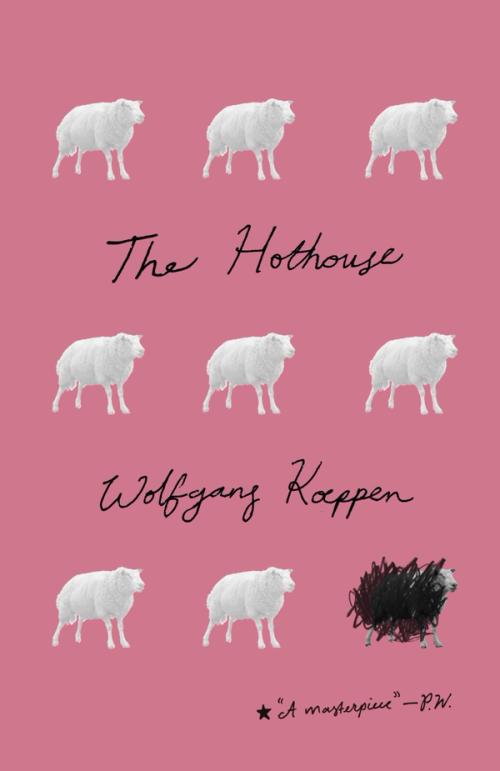
The Hothouse traces the tragic final two days in the life of a minor German politician, Keetenheuve, a man disillusioned by the corruption of his country after WWII. Following his self-imposed exile during the war, Keetenheuve returns to the hothouse: the city of Bonn. Until this point he has led a life guided by principle and political optimism. Here, in spellbinding internal monologue and jarring montage, he meets his end. The Hothouse is an existential masterpiece and a portrait of a moral man crushed by an immoral world.
Bitterly controversial at home and a cult writer abroad, Koeppen (1906– 1996) brought a volcanic modernist style to German literature that remains unparalleled to this day. His uniquely radical voice and breathtaking prose is rendered magnificently by Michael Hofmann.
Wolfgang Koeppen, a remorselessly brilliant German writer of the twentieth century, has long remained scandalously obscure in the Anglophone world.
— Pankaj Mishra
The Hothouse is literature of a quality that is not often attained.
— Frankfurter Allgemeine Zeitung
Exhilarating and original.
— Andrew Martin, Harper's Magazine
Scathing, disillusioned novel ridiculing the notion of a new start and a clean slate for West Germany.
— London Review of Books
Germany’s greatest living writer.
— Gunter Grass
There are rare writers who inform and enthrall, even terrify. The gifted German enigma Wolfgang Koeppen (1906–1990) is one such witness: candid and strange, allusive, unsettling. Time and again Koeppen stage-manages an unforgettable scene.
— The Irish Times
Scathingly beautiful—lyrically inescapable.
— Nadine Gordimer
It is hard to think of a German writer of his generation who has written more sensitively or more profoundly about the Holocaust and its effects than Wolfgang Koeppen.
— Ruth Franklin, The New Republic
A forgotten masterpiece: Michael Hofmann has illuminated a dark corner of recent European history.
— *The Evening Standard *
In a many-toned language Koeppen not only depicts a cacophonous world but peoples that world with individuals whose lives barely overlap. The result documents a uniquely German situation; it also, with its echoes of James Joyce and John Dos Passos, reconnects the German novel at a surprisingly early date to modernist fiction.
— The Independent
Almost eerily contemporary in its concerns, and remarkable as a sidelong, searing appraisal of the legacy of the Nazi years, it is a recovered masterpiece.
— Publishers Weekly (STARRED)
The whorl of Koeppen’s fragments is always steeled by his precision and capacity for revelation, and each word in Hofmann’s translation feels fixed in place as though it were a mortared brick.
— TLS
Those who haven’t read this novel cannot claim to know German literature after 1945.